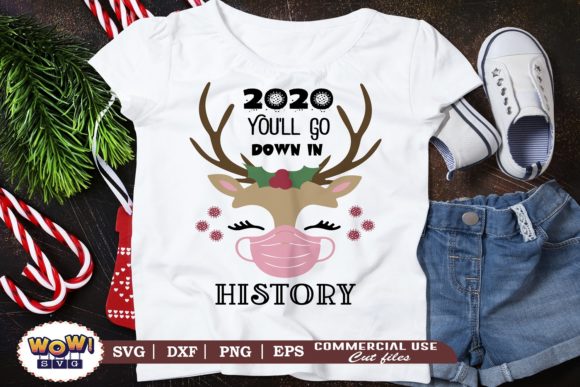
Review: 2020 You Will Go Down in History Design
As a designer who spends more time staring at stitch maps than most people spend on their phones, I approach every new machine embroidery design with a mix of curiosity and skepticism. We have all seen the flood of text-based graphics flooding the market lately, but few carry the weight of recent history quite like this one. Today, I am breaking down the "2020 You Will Go Down in History" file to see if it holds up under the needle or if it's just another digital asset that looks good on a screen but fails on fabric.
My first impression upon opening the folder was relief. The listing promises a ZIP containing SVG, PNG, EPS, and DXF files, which tells me immediately that this is primarily a vector graphic intended for cutting machines or print applications, rather than a pre-digitized embroidery file with built-in stitch data. For those of us running embroidery machines, this distinction is critical. It means we are looking at an Illustrations and Graphics asset that requires manual digitizing or conversion before it hits the hoop. However, the clean lines of the typography suggest it would convert beautifully into a satin stitch or a tight fill stitch if handled correctly.
Visual Personality and Mood
The phrase itself carries a heavy, almost ironic mood. "2020 You Will Go Down in History" is bold, declarative, and slightly cheeky. Visually, the layout is straightforward, relying on strong typography to do the heavy lifting. There are no overly intricate flourishes or tiny details that would get lost in translation when stitched out. This simplicity is its greatest strength. In the world of custom apparel, less is often more. A design like this doesn't need to shout; the text speaks for itself.
When I imagine this as a finished product, I see it working best on items where the message is the focal point. Think of a structured tote bag or the chest of a heavyweight sweatshirt. The boldness of the statement demands a canvas that can support it without distraction. As a piece of design assets for a craft business, it offers a versatile base. Whether you are aiming for a nostalgic look back at a turbulent year or a humorous take on survival, the visual personality adapts well to different thread palettes.
Real-World Application: The Sweatshirt Test
To truly evaluate this, I ran a mental simulation of a real client project. Let's say a customer wants a commemorative sweatshirt embroidery piece to mark the end of a difficult era. They want something they can wear comfortably but that also serves as a conversation starter. Using this graphic as the foundation, I would digitize it with a medium-density fill stitch to ensure durability without making the garment stiff.
If I were stitching this onto a French terry cotton blend, the result would be crisp. The straight lines of the letters would lay flat, and the spacing between characters seems generous enough to avoid thread bunching, a common issue with text-heavy designs. For a handmade product intended for sale on Etsy or at a craft fair, this kind of clarity translates to perceived value. Customers trust a design that looks professional and legible from a distance. It isn't trying too hard, which makes it feel authentic—a key factor for Etsy sellers and boutique owners building a brand based on reliability.
Beyond apparel, this design shines as a tote bag design. Canvas bags provide the perfect tension for embroidery. Imagine this stitched in white thread on a natural beige bag, or perhaps gold metallic thread on a black canvas for a more elevated, boutique feel. It transforms a simple grocery carrier into a statement piece of small shop product inventory. The versatility extends to home goods as well; a kitchen towel or a pillow cover featuring this text could serve as a subtle nod to the times, perfect for a housewarming personalized gift.
Technical Considerations for Embroiderers
Here is where we need to be practical. Since the provided files are vectors (SVG, EPS, DXF) and raster (PNG), you cannot load these directly into your embroidery machine as a digital embroidery file unless your software automatically converts them, which rarely yields optimal results. If you are an embroidery project enthusiast, you must digitize this yourself or hire a digitizer.
When converting this graphic, pay close attention to stitch density. Text designs can easily become too dense, causing the fabric to pucker or the thread to break. For smaller hoop sizes, you might need to simplify the font weight. If you are attempting this on a cap, remember that curved surfaces distort text. You may need to apply a pull compensation adjustment to ensure the letters don't look like they are leaning backward. Also, consider the stabilizer carefully. For stretchy fabrics like jersey knits used in baby embroidery or t-shirts, a cut-away stabilizer is non-negotiable to prevent the design from warping after washing.
Thread color contrast is another vital element. On dark fabrics, a light underlay is essential to prevent the garment color from showing through the stitches. Conversely, on light fabrics, ensure your top thread has enough coverage. Testing on scrap fabric is not just a suggestion; it is a requirement. Run a test stitch-out to check for tiny gaps in the lettering or jagged edges that might ruin the professional look of your finished product.
Commercial Viability and Brand Consistency
For creative entrepreneurs and commercial embroidery professionals, the licensing terms are paramount. While the file formats suggest broad compatibility with design software like Cricut Design Space for cutting vinyl, using it for stitched goods requires verifying the license for commercial embroidery use. Never assume a file meant for cutting is cleared for mass-produced stitched goods without checking.
Assuming the license permits it, this design has high potential for holiday embroidery gifts or end-of-year memorabilia. Its timeless yet specific nature means it won't feel outdated next year; instead, it becomes a historical marker. This adds a layer of storytelling to your products, which enhances buyer engagement. People love buying items with a narrative. By offering this on a high-quality hoodie or a durable patch, you aren't just selling thread on cloth; you are selling a memory.
In terms of printable mockup creation for your online store, the included PNG and SVG files are invaluable. They allow you to create realistic previews of how the design will look on various products before you even stitch a single thread. This helps in gauging customer interest and refining your marketing strategy. A clean, well-presented mockup can significantly boost click-through rates on platforms like Etsy.
Final Verdict
The "2020 You Will Go Down in History" graphic is a solid contender for designers looking to add a touch of recent history to their catalog. Its strength lies in its simplicity and bold messaging. However, its success depends entirely on the execution. As a raw graphic, it is excellent. As an embroidery project, it requires skillful digitizing to ensure the thread colors pop and the fabric texture remains intact.
If you take the time to test your hoop size, select the right stabilizer, and respect the nuances of text stitching, this design can elevate your craft business. It fits seamlessly into collections focused on resilience, humor, and memory-keeping. Just remember to verify the specific license details regarding commercial embroidery before listing your items for sale. With the right preparation, this design is ready to make its own place in history, one stitch at a time.